
The Soul Chooses Its Path
You were born into the right faith, even if almost every sincere seeker eventually asks the same question: am I in the right place? They look at their own tradition, their church, synagogue, mosque, or temple, and wonder whether the depth they hunger for lives somewhere else, in another faith, another practice, another path. They encounter other religions and feel a pull toward something that seems richer, more alive, more true than the faith they were raised in. But perhaps that pull is not restlessness. Perhaps it is memory. Perhaps that feeling of recognition in another tradition is the soul’s way of telling us it has been there before, that it knows these waters, that it has drunk from them in another time. This essay is written for the seeker who knows that pull intimately, and has never quite been able to explain it. What I have come to believe is that the depth you are searching for has never been somewhere else. It has been waiting inside the tradition you were born into all along, in its deepest and most ancient teachings, ready to be uncovered.
I have come to understand that pull through the lens of the soul’s long journey. I believe the soul passes through many incarnations, and that with each return it moves more freely, gradually loosening itself from the ego’s hold through the lessons each life brings. I also believe the soul incarnates across different religions, experiencing each one as a kind of school, absorbing the wisdom and traditions unique to that path. No religion, in my view, stands above another. Each serves a distinct purpose. The soul does not wander aimlessly. It chooses its next path, its next education, and each choice draws it deeper toward the wholeness it has always been seeking. That is what I believe, and if it is true, then the faith you were born into is not an accident. It is an assignment.
I have come to this understanding not only as a belief, but as something I lived. In my early thirties, after growing up in the Christian faith, I found myself sitting quietly with a question I had never quite dared to ask before: was I in the right faith? I did not ask it with urgency or crisis, but with a quiet wondering, turning it over gently within me. Looking back, I understand now that the question itself was the beginning of a deeper journey. Not long after, I felt drawn, even guided in a way I still cannot fully explain, toward the mystical and spiritual dimensions of the five main world religions, traditions I had no idea even existed. What I encountered in those beliefs and practices deeply moved me with their depth, their beauty, and their wisdom. Beneath all the different names, rituals, and languages of prayer, the core message in every one of these mystical traditions was the same: the soul’s union with God.
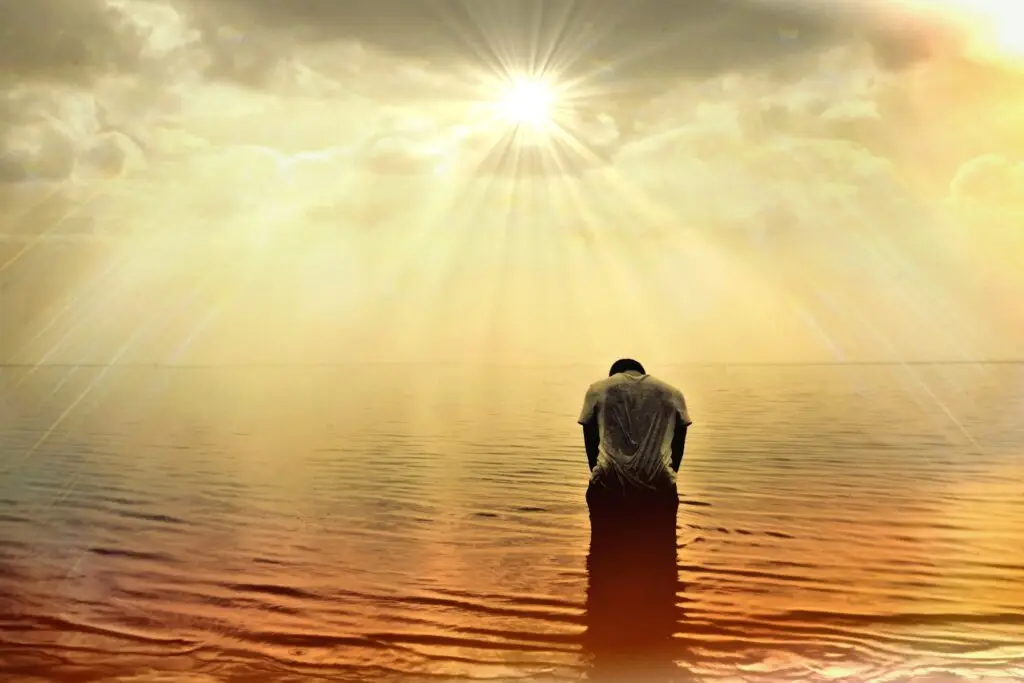
Discovering that the deepest teachings of each faith pointed toward the soul’s union with God filled me with a happiness I had not expected. I had grown up watching religion divide people, setting them apart from one another. And here, in the oldest and deepest teachings of each tradition, was a truth so universal it could belong to everyone. Not a truth that erased our differences, but one that transcended them. Union with God was not merely a Christian idea, or a Jewish idea, or a Muslim idea, or a Hindu idea, or a Buddhist idea. It was a human longing, the one we had all been reaching toward, in our different ways, all along. Rather than pulling me toward another tradition, these discoveries drew me deeper into my own. They also opened my heart in a way I had not anticipated, filling me with reverence for all these paths, seeing in each one a different face of the same sacred truth. Today I no longer ask whether I was born into the right faith. I know that I was. And I understand now that the question was not pulling me away from anything. It was a quiet nudge from my soul to go deeper into the faith in which I was born.
“The soul is not lost because it questions the path it was born into; sometimes the question itself is the doorway that leads it deeper into God.”
When Religion Forgot Its Mystical Heart
But that joy also led me to a more sobering realization. What I discovered on that journey was both humbling and revelatory. In their purest and most original forms, these traditions were profound beyond anything I had imagined. Yet I also came to understand that over many centuries, the mystical heart of religion had often been overshadowed by doctrine, institution, and authority. These deeper teachings had not disappeared, but they had been pushed to the margins, overlooked by many who entered their churches, synagogues, mosques, and temples without ever being shown the hidden depth within them. They had not been lost. They had simply been forgotten.
This movement away from mystical teaching and toward the outer structures of religion is especially visible in the Abrahamic traditions of Judaism, Christianity, and Islam. While every religion changes over time, Hinduism and Buddhism have preserved their contemplative and mystical dimensions more openly within their central practices. In the Abrahamic faiths, however, those deeper currents were often pushed beneath the surface as the external forms of religion became more dominant. Yet they were never extinguished. Kabbalah in Judaism, the lives and teachings of the saints in Christianity, and Sufism in Islam all bear witness to the mystical flame that continued to burn within them. Beneath the surface of three seemingly distinct religions, that flame has been burning all along.
The Lost Years of Jesus and the Wisdom He Gathered
If the mystical heart of religion can be hidden, forgotten, and later rediscovered, perhaps no figure embodies that pattern more powerfully than Jesus himself. The New Testament gives us only glimpses of his early life: his birth, his flight into Egypt as an infant, and one luminous moment at the age of twelve, when his parents find him in the Temple in Jerusalem, seated among teachers and elders, engaging, questioning, and answering with an understanding that left those around him astonished. Then the record falls silent. From the age of twelve to the age of thirty, there is nothing, only a silence so complete that it has stirred the curiosity of scholars, mystics, and seekers for centuries. When he reappears, he is thirty years old, stepping into the Jordan River to be baptized and begin his ministry. Eighteen years are missing from the story. The Bible does not account for them, explain them, or even address them.
What filled those years? No one knows for certain. The Bible offers nothing. Tradition often assumes that Jesus remained in Nazareth, quietly learning the carpenter’s trade, but that too is an assumption. The only scriptural hint we receive comes from the Gospel of Luke, which leaves us with a single luminous sentence: “And Jesus grew in wisdom and stature, and in favor with God and man” (Luke 2:52). Across centuries, many seekers, mystics, and spiritual writers have believed that he traveled. Egypt, one of the great centers of ancient mystical knowledge, where the mysteries of life, death, and resurrection had been studied and practiced for thousands of years, may have been one of his destinations. India, where the traditions of yoga, meditation, and the nature of the soul had been refined over millennia, may have been another. And closer to home, many believe he spent time among the Essenes, a Jewish mystical sect living in the desert, devoted to prayer, purification, and the inner life. For those who hold this view, each of these traditions carried a distinct and ancient wisdom that deepened his spiritual formation. In this view, he did not travel to abandon his faith. He traveled to enrich it, gathering the deepest teachings of human spiritual knowledge and bringing them home, so that he could offer the world a new understanding of God. Perhaps the first sign of that hidden preparation appeared not in those missing years, but at his birth, when the Magi arrived bearing gifts.
The Magi and the Gifts That Revealed Jesus’s Path
The Magi, the wise men who followed a star to the place where Jesus was born, were more than visitors bearing gifts. They were priest-astronomers from the East, scholars of the stars and the sacred, steeped in their own ancient mystical traditions. They did not come merely to pay tribute. Many believe their visit carried a far deeper purpose: that they came as representatives of the very traditions that would later receive and shape Jesus during what many call the missing years. Each gift they carried was a declaration. Gold, the metal of gods and rulers, announced that this child carried a divine authority no earthly throne could contain. Frankincense, the sacred incense burned in temples across the ancient world, carried the scent of prayer, of the mind stilled and lifted toward God. To offer it here was to recognize that this child would walk the inner path, emerging from the depths of prayer and meditation with the fire of divine awareness. And then there was myrrh, an embalming oil, a gift that belonged not to the newborn but to the dead. To place it at a cradle was to acknowledge that this radiant life was already pointing toward death, and beyond death, toward something greater. It was not a gift of mourning, but of transcendence. Together the three gifts told a complete story: kingship, enlightenment, and transcendence. The Magi knew exactly who lay before them.
If the gifts revealed what the Magi saw in Jesus, the journey itself revealed something even deeper: they had been led there. In this view, they were guided by God, and their gifts were more than offerings; they were the first signs of a sacred curriculum that would one day open before Jesus. Through that divine orchestration, God was preparing not merely a teacher or a prophet, but a living demonstration of what every human soul carries within it and the wholeness every soul is reaching for.
Fully Human, Fully Divine and the Wholeness Within Us
That living demonstration began in the mystery of his own nature. Jesus came into this world fully human and fully divine, not as a distant miracle worker, elevated and untouchable, but as one who entered completely into the human condition. He walked the road we walk, felt what we feel, and struggled as we struggle, so that through his life he could reveal something we have forgotten about ourselves: that we too carry both the human and the divine within us. These two natures are not in conflict. They are the wholeness every soul is reaching for, no matter which faith it has chosen as its path.
But this wholeness is not reached without purification. It asks us to face everything within us that is still ruled by ego, fear, separation, or illusion. Before Jesus could teach, before he could heal, before he could offer the world a new understanding of what it means to live, Jesus went into the wilderness alone. Forty days. No food, no comfort, no community. Only silence, and the full weight of his humanity pressing against the divine flame within him. He was tested, tempted, and stripped of every earthly consolation. And he emerged transformed, the human and the divine no longer pulling against each other, but unified, purified, whole.
He moved through this purification with a swiftness few of us are likely to know, and that too was intentional. He did not come to linger on the path. He came to illuminate it, revealing in one concentrated, luminous life what becomes possible when the ego yields completely to God. The forty days in the wilderness were not a detour from his mission. They were the heart of it, his way of showing us: this is the path. This is what purification looks like. This is what waits on the other side.
In this way, the life of Jesus is not separate from the journey this essay began with: the soul moving through many incarnations, choosing in each life the faith best suited to its path, and reaching for wholeness as the ego loosens its hold. His life is that journey made visible, concentrated into a single lifetime, offered to us as a lantern in the dark. What the soul moves through across many lifetimes, he revealed in one. Not to shame us for our slowness, but to show us the way home: union with God.
The Wisdom Waiting Within Your Own Faith
And so the journey returns to us. If the soul truly incarnates across many lifetimes, choosing in each one the faith best suited for that particular path, then we need not leave our own tradition to find the depth we seek. We can remain open to the deeper wisdom in every religion, allowing it to expand our reverence, but we do not have to abandon the faith our soul chose for this incarnation in order to draw closer to God. The soul born into Judaism, Christianity, Islam, Hinduism, or Buddhism was born there for a reason. The wisdom is not somewhere else. It lives within the tradition you were given, in its mystical teachings, in its most ancient and uncorrupted wisdom, waiting to be uncovered from within. You need not cross the world to find what your soul already knows. You need only go deeper into where you already are.
Author Note
I did not come to these ideas through study alone. They unfolded slowly through my own life, through questions I carried quietly for years, and through a longing to understand why the faith I was born into both held me and left me searching for something deeper. What I found, as I looked more closely into the mystical heart of Christianity and the wisdom carried within other traditions, was not a reason to leave my faith, but a reason to enter it more deeply. This essay is my way of sharing that journey with anyone who has ever wondered whether the faith they were born into might still be waiting to reveal more beauty, wisdom, and depth than they once imagined.